
Mapping
Mapping’ is a technique that involves summarising what each paragraph in the Verbal Reasoning subtest is telling you in a sentence or less. Let’s break down an example of a text to map:
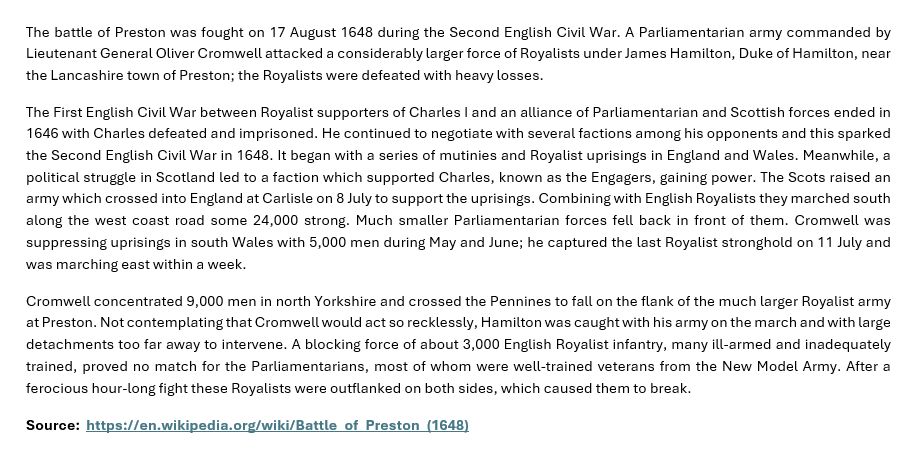
First, we briefly skim each paragraph to get an idea of what is going on. You’ll usually get the main gist in the first 1-2 sentences, but might want to read further to be certain.
From the passage above, I may choose to name each paragraph as follows:
- Paragraph 1: Introduction to battle of Preston & parties involved
- Paragraph 2: Background to the conflict
- Paragraph 3: Details on the conflict
When reading the question, we make a snap decision of what paragraph we are going to read to find the answer.
Let’s imagine a question asked us this:
According to the passage, which of the following best explains why the Royalists were defeated at Preston?
Just from reading the question we can make an educated guess that the answer will be in the last paragraph as it is the one giving the most detail on how the battle was lost. So we read it in full and come back to (imaginary) answer options:
A. The Royalist army was outnumbered by Cromwell’s Parliamentarians.
B. The Royalists lacked sufficient support and training.
C. Cromwell had been reinforced by Scottish Engagers.
D. The Royalists had recently suffered a series of mutinies and uprisings.
The answer is B – the paragraph best supports the idea that, while outnumbered, the Royalists were mainly defeated due to detachments being too far away to intervene and lack of training.
Something to note:
This technique is best suited to the ‘General Comprehension’ style of questions that ask about specific events in the passage. It can similarly be used for ‘True/False/Can’t Tell’ questions, even if you might find that you already have a technique for these that works fine.
If the inference-heavy questions (i.e. ‘Writer’s Opinion’, ‘Main Argument’) are too difficult to answer on this technique alone, we may want to skip and come back to them and see if for the same passage there are other questions that are easier to answer. This helps to build a picture of what the passage is about before coming back to the less straightforward questions.